

It's not clear if or when boosters doses of Covid-19 vaccines will be OK'd for fully vaccinated people in the United States, but state and local health departments across the United States are moving ahead with plans for a potential rollout next week.
Last month, US health officials announced plans for booster doses of Covid-19 vaccine to be offered starting the week of September 20, subject to sign-off from the US Food and Drug Administration and the US Centers for Disease Control and Prevention.
Those conversations are getting underway this week, including a key meeting of FDA vaccine advisers on Friday, but the decision isn't a slam dunk, experts have said.
Still, those tasked with administering boosters can't wait for the details to be finalized.
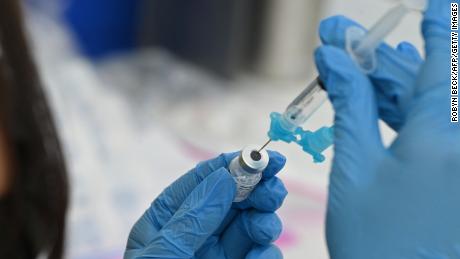
"We don't want to be unprepared," Lori Tremmel Freeman, chief executive officer of the National Association of County and City Health Officials, told CNN on Wednesday.
She said that local health departments are planning now to be ready after the FDA review's Pfizer data -- especially, as they already are "really overwhelmed" right now with responding to surges of Covid-19 cases, working to get the unvaccinated vaccinated, and preparing for the flu season.
The last thing local health officials need at the moment is more chaos or confusion, but many of their questions around boosters still have not been answered: "What is the interval for boosters? Is it any shorter than eight months at this point? What is the age cut-off? Will there be priority groupings?" Freeman said. "We don't want to appear uncoordinated on boosters."
What has to happen before boosters go into arms?
The FDA's Vaccines and Related Biological Products Advisory Committee will meet this Friday to discuss whether data on Pfizer/BioNTech's Covid-19 vaccine support the idea of giving a booster dose to people 16 and older about six months after they complete their second dose. And there will be more steps before boosters will be OK'd to go into arms of the general public.
"It's important to note that the FDA's role is really to say can we use this -- can we use this product or can we use this booster. It's the CDC who will decide whether or not they should be used," Dr. Anna Durbin, director of the Center for Immunization Research at the Johns Hopkins Bloomberg School of Public Health, said during a virtual briefing on Wednesday.
How many people might be eligible for boosters?
It's not clear what parameters the US booster program will have, if it launches at all.
The Biden administration previously said US residents would be eligible for a third dose of Covid-19 vaccine eight months after receiving their second dose.
In that case, up to 5.2 million people may be eligible to receive a booster shot, or third dose, of a Covid-19 vaccine during the week of September 20, if the booster program began then.
Data from the CDC shows that about 3.4 million US residents were fully vaccinated by January 20, which would make them eligible for a booster shot eight months later on September 20. Up to 5.2 million people may be eligible for their booster shot by the end of the week.

The initial booster rollout is on track to include Pfizer/BioNTech doses -- pending authorization from the FDA -- but it may take a few weeks longer to move forward with boosters of Moderna's vaccine.
Johnson & Johnson has been studying the possibility of adding a second dose as a booster to its one-shot vaccine, and it "continues to diligently generate and evaluate data from ongoing trials as well as emerging real-world evidence," according to the company. J&J said it also was in discussions with the FDA and CDC about the need for offering a booster dose of its Janssen vaccine.
More than half, 56%, of the doses administered by January 20 were Pfizer/BioNTech doses, data from the CDC shows. In December, the FDA authorized the Pfizer/BioNTech vaccine for emergency use about a week before the Moderna vaccine. The Johnson & Johnson vaccine was authorized in February.
Public health officials and medical experts at the US Department of Health and Human Services noted in a joint statement in August that the booster rollout could be phased by default since the initial rollout of first doses was phased.
For instance, if the boosters are recommended for people six to eight months after receiving their second dose, health care workers and older adults would likely will be the first eligible group to receive booster shots if a rollout happens next week.
If someone received their second dose in January, that was eight months ago. March was six months ago.



0 Comments